
Cybersecurity
Learn why modern endpoint security needs Vulnerability Ops—and how Intune, Edge for Business, and Security Copilot turn risk into action.
Security teams have never had more visibility into risk.
That is not the same thing as reducing it.
Organizations can identify vulnerable applications, risky configurations, outdated software, problematic browser extensions and excessive privileges faster than ever. AI is accelerating that discovery even further.
But finding the problem is only the beginning.
The real question is: what happens next?
At M365 Community Days NYC, Devicie CEO Alex Hesterberg explored a shift we believe is becoming increasingly important for modern IT and security teams: moving beyond traditional vulnerability management toward Vulnerability Operations — Vulnerability Ops.
Because detection does not reduce exposure.
Action does.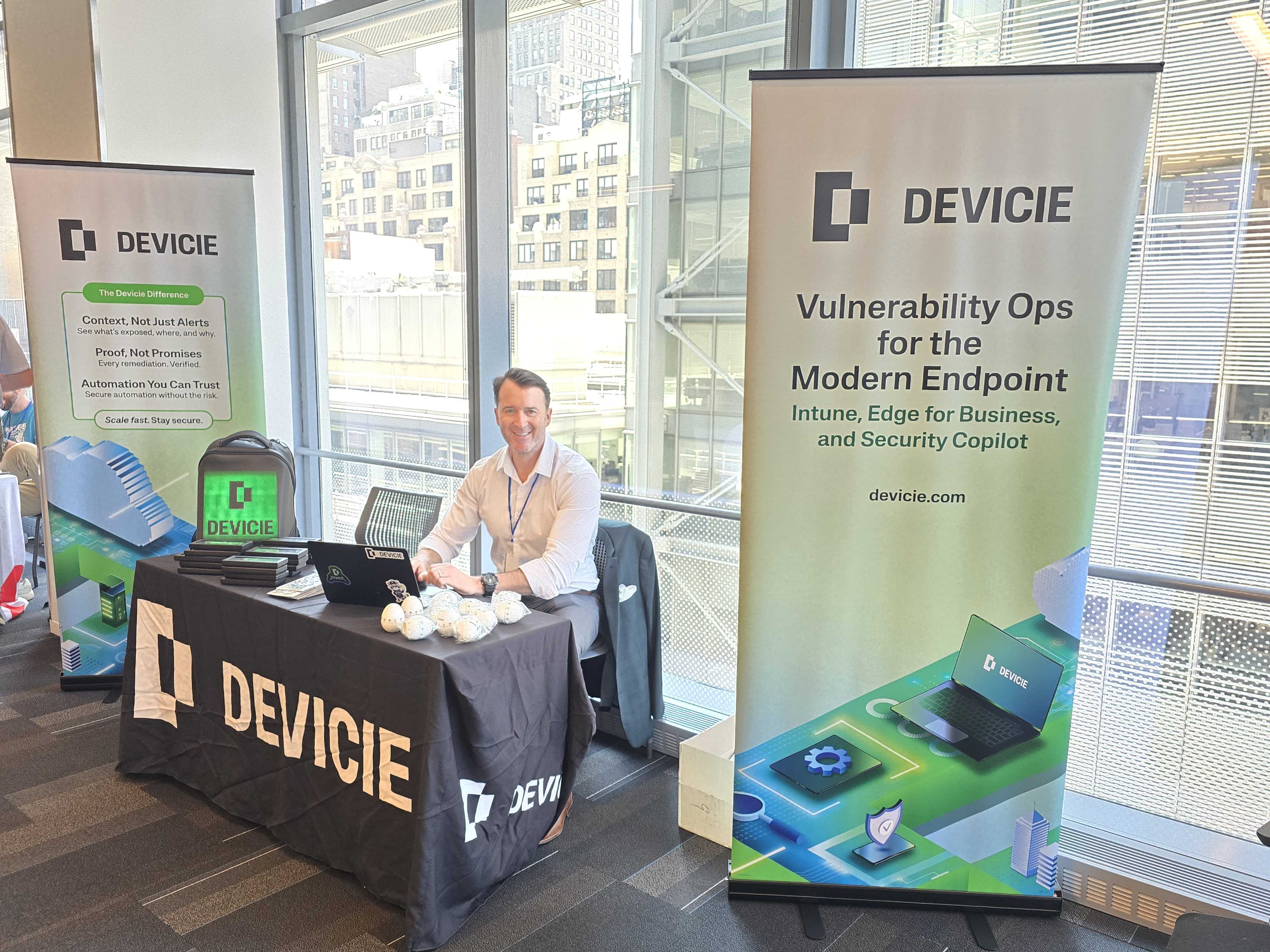
The endpoint is no longer just the device
For years, endpoint management largely meant managing the laptop.
That model no longer reflects how people work.
The modern endpoint now includes the device itself, the applications installed on it, browser profiles and extensions, configuration policies, local privilege and the growing layer of AI interacting with all of them.
Each creates another place where security intent and operational reality can diverge.
An application falls behind on patches.
A browser extension gains access it should not have.
A security baseline exists in policy but is not actually enforced.
A temporary local administrator exception becomes permanent.
A device appears compliant until someone needs to prove exactly what happened and when.
These are security problems.
But they are also operations problems.
Vulnerabilities are often operational failures wearing a security label
Traditional vulnerability management is very good at helping organizations answer questions such as:
- What is vulnerable?
- How serious is it?
- Which assets are affected?
- What should we fix first?
Those are essential questions.
But knowing that a vulnerability exists does not patch an application. A risk score does not correct configuration drift. A dashboard does not remove a dangerous browser extension. A remediation recommendation does not revoke unnecessary local administrator access.
And that is where exposure often persists.
Alex highlighted several recurring examples: patch lag, browser extension risk, configuration drift, compliance blind spots and local administrator sprawl.
The common denominator is not a lack of information.
It is the gap between knowing and doing.
Vulnerability Management finds risk. Vulnerability Ops turns risk into change.
That distinction matters.
Vulnerability Management helps organizations discover, prioritize and understand exposure.
Vulnerability Ops operationalizes the response.
It turns a security signal into an application patch.
A configuration change.
An extension block.
A privilege reduction.
A verified compliance state.
Evidence that remediation actually happened.
That is the shift from signal to action.
And it requires more than adding another dashboard.
It requires a repeatable operating loop.
The modern Vulnerability Ops loop
A practical Vulnerability Ops model follows six steps:
1. Discover
Understand the state of devices, applications, browsers, extensions, policies and privilege.
2. Prioritize
Evaluate risk alongside exploitability, user context and business impact.
3. Configure
Translate the remediation decision into deployable policy or configuration.
4. Remediate
Patch. Remove. Block. Update. Reset. Reduce privilege.
5. Verify
Confirm the resulting state through compliance, telemetry, reporting and exception management.
6. Explain
Use operational context and natural language to help teams understand what happened, what matters and what should happen next.
This is not a one-time workflow.
It is a loop.
And every stage needs to become repeatable, automated and provable.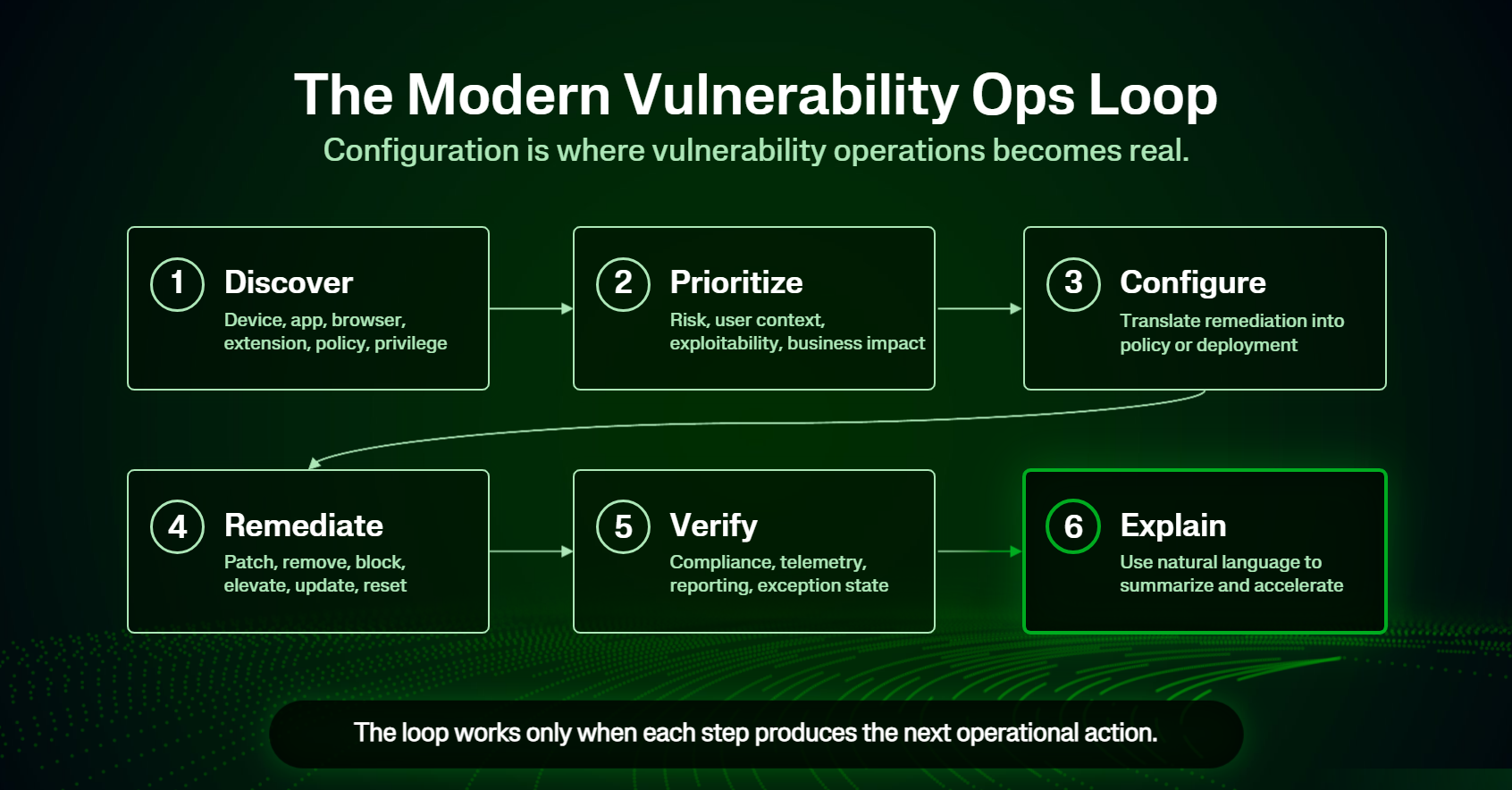
Intune becomes the remediation control plane
Microsoft Intune already gives organizations many of the controls necessary to turn security decisions into endpoint change.
Configuration policies.
Security baselines.
Application deployment and updates.
Endpoint security controls.
Compliance rules.
Privilege management.
The opportunity is to stop treating those capabilities as separate administrative functions and instead bring them into one vulnerability remediation motion.
Because if an organization cannot configure it, remediate it and prove it, it does not yet have Vulnerability Ops.
This becomes particularly important with configuration drift.
There is always a difference between:
What should be true & what is actually true.
Policies change. Devices change. Users change. Exceptions accumulate.
A strong Vulnerability Ops model continuously reconciles baseline intent with device reality; identifies the gap, determines the appropriate action and verifies the result.
The browser belongs in endpoint security
The browser also deserves a larger role in this conversation.
For many employees, the browser has become the primary interface to work.
Microsoft 365.
SaaS applications.
Internal systems.
AI tools.
Sensitive organizational data.
Yet browser posture has historically been treated as something adjacent to endpoint management rather than part of it.
That needs to change.
Microsoft Edge for Business gives IT teams control over profiles, policies, extensions and organizational data across managed environments.
Browser extensions are a perfect example of why the Vulnerability Ops approach matters.
Knowing an extension is installed is not enough.
Teams need to know:
What does it access?
Who is using it?
What other risk exists on those devices?
Should it be allowed, blocked or removed?
Did that action actually happen?
Extension governance should not live in a spreadsheet.
It should live inside the same operational remediation loop as the rest of the endpoint.
AI makes context faster. Operations still have to close the loop.
AI changes the equation again.
Microsoft Security Copilot can help teams ask better questions of their security environment and dramatically compress investigation time.
Which devices are exposed by this application version?
Where is a policy assigned but failing to apply?
Which users have both risky browser extensions and local administrator privileges?
What remediation path can we prove tomorrow?
These are powerful questions because natural language becomes far more useful when it is connected to real operational context.
But AI does not eliminate the need for operational execution.
The goal is not simply to generate a better answer.
The goal is to move from:
Question → Context → Decision → Action → Proof.
Put the stack into motion
Consider a simple example.
A high-risk browser extension appears on several Finance devices.
That is the signal.
Additional context reveals that three of those devices are also running stale application versions and still have persistent local administrator privileges.
Now the problem looks very different.
The appropriate response may involve blocking the extension, updating the application, reducing privilege and creating an exception only where it is justified.
Intune and Edge policies can execute the remediation.
Compliance and endpoint telemetry can prove the resulting state.
The value is not any one security signal.
The value is correlation and the speed with which the organization can act on it.
This is the next endpoint operations challenge
AI will continue making vulnerability discovery faster.
Security tooling will continue generating better signals.
Attack surfaces will continue expanding across devices, applications, browsers, identities and AI.
That makes the operational layer more important, not less.
The organizations that get ahead will be the ones that can turn risk into governed change quickly, consistently and with evidence.
That is what Vulnerability Ops is ultimately about.
Not another vulnerability dashboard.
Not another list of things someone needs to fix.
A closed loop from detection through remediation and proof.
Because detection alone does not reduce exposure.
Closed-loop execution does.
Frequently Asked Questions About Vulnerability Ops
What is Vulnerability Ops?
Vulnerability Ops is an operational approach that turns identified security risk into configuration, remediation, verification, and proof. Rather than stopping at vulnerability discovery or prioritization, Vulnerability Ops creates a repeatable process for acting on risk across devices, applications, browsers, policies, extensions, and privilege.
A modern Vulnerability Ops loop typically includes six stages: discover, prioritize, configure, remediate, verify, and explain.
What is the difference between Vulnerability Management and Vulnerability Ops?
Vulnerability Management identifies and prioritizes risk. Vulnerability Ops turns that risk into operational change.
Traditional Vulnerability Management focuses on capabilities such as asset visibility, exposure scoring, remediation guidance, and security reporting. Vulnerability Ops extends that process into actions such as application patching, policy updates, browser extension response, privilege reduction, and compliance verification.
In simple terms: Vulnerability Management tells you what needs attention. Vulnerability Ops helps ensure something actually happens next.
Why is traditional vulnerability management no longer enough?
Modern organizations generally do not suffer from a lack of security signals. The greater challenge is converting those signals into timely, consistent, and provable remediation.
Exposure can persist because of delayed application updates, configuration drift, risky browser extensions, compliance gaps, persistent privilege, or disconnected ownership between IT and security teams.
Detection is essential, but detection alone does not reduce exposure. Organizations also need the operational capability to act on what they discover.
What is considered a modern endpoint?
A modern endpoint extends beyond the physical laptop or mobile device.
It includes the device, applications, browser, browser extensions, configuration policies, local privilege, and the growing layer of AI used to understand and act on endpoint context.
Managing these surfaces as one connected environment gives IT and security teams a more complete view of both endpoint risk and remediation.
How does Microsoft Intune support Vulnerability Ops?
Microsoft Intune can serve as a remediation control plane for Vulnerability Ops by translating security decisions into endpoint configuration and change.
That can include application deployment and updating, security baselines, policy assignments, endpoint security controls, compliance rules, exception handling, and endpoint privilege management.
The goal is to connect risk signals with the policies and actions required to remediate them — and then verify that the intended state was achieved.
Why should browser security be part of endpoint management?
The browser has become a primary work surface and should be treated as part of the managed endpoint estate.
Employees increasingly access SaaS platforms, Microsoft 365, internal systems, sensitive organizational data, and AI tools through the browser.
Browser profiles, policies, extensions, and data controls can therefore materially affect endpoint posture. Microsoft Edge for Business provides management capabilities across these areas, making browser posture an important component of a broader Vulnerability Ops strategy.
How does AI change vulnerability operations?
AI can accelerate the investigation and decision-making stages of Vulnerability Ops by helping teams turn large amounts of endpoint context into useful questions and answers.
For example, teams may want to understand which devices are exposed by a particular application version, where policies are failing to apply, or which users combine risky extensions with persistent local administrator privileges.
Security Copilot can help teams move from question to context to decision more quickly, while endpoint management and security controls remain responsible for executing and proving the resulting action.
What is configuration drift, and why is it a security risk?
Configuration drift occurs when the actual state of a device or environment no longer matches the organization's intended security baseline.
Policies, users, devices, applications, and exceptions change over time. Without continuous reconciliation, the configuration an organization believes is enforced may differ from what is actually happening on endpoints.
A Vulnerability Ops model continually compares baseline intent with device reality, detects gaps, initiates the appropriate action, and verifies the resulting state.
What does closed-loop vulnerability remediation mean?
Closed-loop remediation means connecting detection, context, decision, action, and proof into one operating motion.
A risk signal is detected. Endpoint context establishes what is actually affected. Teams determine the appropriate response. Policies and controls execute the remediation. Finally, compliance and telemetry verify that the change occurred.
The objective is not simply better visibility or another dashboard.
It is fewer exposed endpoints and better proof that remediation happened.
How can organizations start implementing Vulnerability Ops?
Organizations do not need to transform their endpoint environment overnight.
A practical starting point is to:
- Baseline: Inventory devices, applications, browser policies, extensions, patch posture, privilege, and compliance gaps.
- Standardize: Establish expected configurations, browser posture, application lifecycle policies, privilege controls, and exception processes.
- Automate: Introduce policy-driven remediation, continuous reporting, and repeatable verification.
The goal is to progressively turn high-risk security signals into governed, repeatable remediation workflows.
How does Devicie support Vulnerability Ops?
Devicie helps organizations operationalize modern endpoint management by connecting endpoint context with repeatable configuration, remediation, and verification across the Microsoft ecosystem.
The objective is to help IT and security teams move beyond visibility toward closed-loop execution, using technologies including Microsoft Intune, Edge for Business, and Security Copilot as part of one operating motion.
Detection tells you there is a problem. Vulnerability Ops helps you do something about it.
See what your own tenant reports
An Intune Health Assessment reviews your current configuration, shows where the gaps are and prioritises what to address first. Your team runs a read-only collection script.
Request your free assessment